Hey there.
This year I've chosen time as my personal theme for Global Accessibility Awareness Day. Your time is your most precious resource. Obvious no? Yet the value of your time is only there if you spend it in a way that you can be happy about, even (or especially) retrospectively. Your time is also the greatest gift you can give whether it is time to read stories to kids, time to listen to someone in need of your ear, time to solve problems, time to make a website or app accessible, and so on. You are busy. I know. I'll try to use less commas.
I once worked with a remarkable dude named Jon Thomas Kameoka. He ran our local network. Jon was well acquainted with the patience aspect of human-time as it took quite a while for him to physically articulate words. When I first met him I wasn't sure how to interact, and some people seemed to interact with him with a few words, quick waves and nods. I was busy. Then one day when we were alone I decided to try a real conversation. I quickly realized he was just a sharp dude with physical obstacles. Later, whenever I spent the time to listen carefully I was often well rewarded as his satirical wit was shatteringly funny. He actually toiled to produce speech for the gift of entertainment! I regret all those times I rushed past him or cut our conversation off early because I had to get back to work. I could have made up the time. I can't make up the time with Jon anymore. I do not regret any of those times I stopped to chat. These days I occasionally come across things that remind me of him and how the time-patience battle often gets in the way. A recent reminder for me was coming across a commencement address by David Foster Wallace:
I'm not sure how I feel about the video since it feels a little obvious eh? Awareness and perspective are vital. Self-centered thinking is a prison. It is a trap. I want to say decide for yourself how you want to assess time and value. How do you value grace? I think rushing slows you down; give your time while you can.
[Hey I just saved you a few minutes by editing out a rambling philosophical digression.] Anyways, without getting caught up in debate about the concept of time let's at least agree it is something we can't live without. Sadly time takes precious things away from us. On this day, can you take 59 minutes to investigate accessibility in your workplace and in your products? Research accessibility, reach out to peers, ask questions. I am sure you will be rewarded for it, especially if it gives you new perspective. Sorry about that last comma.
Showing posts with label disability. Show all posts
Showing posts with label disability. Show all posts
Thursday, May 9, 2013

Sunday, March 22, 2009
CSUN's 2009 Accessibility Conference
Late last week I attended the 2009 Technology & Persons with Disabilities Conference, a conference which most of us accessibility folks call "c-sun" as it has been held at CSUN for over 20 years. What makes this an exceptionally important conference for accessibility is that it brings users, developers, educators, clinicians, visionaries, and policy makers together in one place. Thankfully a lot of them seem to love Firefox... and for good reason; more on that later.
I was particularly jazzed about getting time in the same room with other Firefox developers: Alexander Surkov, Marco Zehe, and Aaron Leventhal. We spent some mornings, afternoons, and evenings together discussing the past, present, and future of web accessibility, children, wives, and vodka. When people had faded into their rooms, Alexander and I used the later hours to hack together and discuss gecko accessibility code design. His patch reviews are even faster than usual when he's sitting next to me.
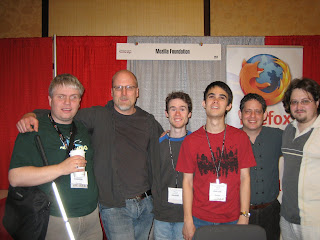
Mozilla works hard "to ensure that the Internet is developed in a way that benefits everyone". It seems pretty clear Mozilla, especially with the work in WAI-ARIA for DHTML, has developed a reputation for pioneering accessibility. As UI issues arise on the web people are looking to Mozilla for answers, and we are keen to work with other communities to find the right solutions. To this end I made sure to get some face time with people at CSUN that I think will help, including Henny from Opera, and JP from Microsoft. In some cases attendees made sure to find me. Flattering. Anyways, I won't bather on much longer as I think Marco will be giving a much better report soon.
Smiling in the picture up above are: Marco Zehe, David Bolter (me), the NVDA developers Mick Curran and James Teh, Aaron Leventhal, and Alexander Surkov (Eitan was absent for this photo). I quite like how Marco's cane glows like a Jedi weapon in this shot.
May the force be with us.
I was particularly jazzed about getting time in the same room with other Firefox developers: Alexander Surkov, Marco Zehe, and Aaron Leventhal. We spent some mornings, afternoons, and evenings together discussing the past, present, and future of web accessibility, children, wives, and vodka. When people had faded into their rooms, Alexander and I used the later hours to hack together and discuss gecko accessibility code design. His patch reviews are even faster than usual when he's sitting next to me.

Mozilla works hard "to ensure that the Internet is developed in a way that benefits everyone". It seems pretty clear Mozilla, especially with the work in WAI-ARIA for DHTML, has developed a reputation for pioneering accessibility. As UI issues arise on the web people are looking to Mozilla for answers, and we are keen to work with other communities to find the right solutions. To this end I made sure to get some face time with people at CSUN that I think will help, including Henny from Opera, and JP from Microsoft. In some cases attendees made sure to find me. Flattering. Anyways, I won't bather on much longer as I think Marco will be giving a much better report soon.
Smiling in the picture up above are: Marco Zehe, David Bolter (me), the NVDA developers Mick Curran and James Teh, Aaron Leventhal, and Alexander Surkov (Eitan was absent for this photo). I quite like how Marco's cane glows like a Jedi weapon in this shot.
May the force be with us.
Thursday, September 11, 2008
Capability
On a recent thread over on wai-xtech, T.V. Raman brought up the notion of talking about capabilities instead of disabilities. I like this. I'm reminded of my old post which played with the definition of disability.
Furthermore, a request for adaptation should never have to be a statement about the physical individual. It should be a statement about a preference in context. I want captions when watching television with the volume down, and I want a ramp when pushing a stroller.
Furthermore, a request for adaptation should never have to be a statement about the physical individual. It should be a statement about a preference in context. I want captions when watching television with the volume down, and I want a ramp when pushing a stroller.
Tuesday, March 11, 2008
Personalized UI Generation
Working on campus has its benefits.
On Tuesday I attended a talk by Krzysztof Gajos titled: "Automatically Generating Personalized Adaptive User Interfaces". It was nice to see some solid research being done in this area with particular attention to users who have a motor/dexterity impairment. Here are some of my notes which of course may have wild inaccuracies.
Krzysztof seems to have applied theory in mathematics and algorithms, particularly "decision theoretic optimization" to graphical user interfaces. I'm not talking about Fitt's law. Think: AI meets HCI.
For his problem space he considers 3 things to adapt the GUI to:
1. devices
2. preferences
3. abilities
And things to adapt, or "UI building blocks":
A. Layout
B. Widget
C. Structure
D. Size (this last one he added later in his research)
The context seemed to be mouse based interaction in graphical user interfaces.
Treating GUI design as an optimization problem he developed quantitative metrics and a cost function, essentially with weights to be applied to widgets. For those with an AI background his bag of tricks included: branch-and-bound search and full constraint propagation. The "cost" function I think of as a "utility" function (common in game decision AI). Oh and perhaps most wonderful to hear him say was that "deep down it is a constraint satisfaction problem". Yes! I'm sort of known for saying a lot of things boil down to a constraint satisfaction problem and some of my colleagues would have a good laugh about this I think. Anyways, this isn't about me and I've lost track of what this paragraph is for.
He spoke of the geometric concepts that arise from considering each UI preference an axis in a multidimensional space, and that each preference of one UI element over another is a hyper-plane in that space. Overall the 'shape' of the solution space of elements that solve the preference criteria is a polytope. Way cool stuff to think about at a high level.
He mentioned four elements of UI Design:
a. Perceived effort
b. Cognitive effort
c. Motor effort
d. Aesthetics
In analyzing ability, or motor effort, he optimized for time as opposed to preference:
cost(rendering(UI)) = time
So what did I take away?
1. People without mobility impairments found the time optimized generated GUI ugly.
2. Everyone was more performant using their generated time optimized GUI.
3. Krzysztof is someone to watch.
4. The biggest gain in performance was using a widget or widget set that required less mousery to manipulate, for example: a set of 5 radio buttons, instead of a combo box with 5 options.
Krzysztof really made his algorithms quick and it was interesting to see a demo of UI changing dramatically as he changed a constraint, such as screen size. The widgets, and widget hierarchy changed on-the-fly, for example, widget groups became tab panels in an auto-generated tab container.
But no spinning angry face. Sorry... inside joke.
Thanks for reading.
On Tuesday I attended a talk by Krzysztof Gajos titled: "Automatically Generating Personalized Adaptive User Interfaces". It was nice to see some solid research being done in this area with particular attention to users who have a motor/dexterity impairment. Here are some of my notes which of course may have wild inaccuracies.
Krzysztof seems to have applied theory in mathematics and algorithms, particularly "decision theoretic optimization" to graphical user interfaces. I'm not talking about Fitt's law. Think: AI meets HCI.
For his problem space he considers 3 things to adapt the GUI to:
1. devices
2. preferences
3. abilities
And things to adapt, or "UI building blocks":
A. Layout
B. Widget
C. Structure
D. Size (this last one he added later in his research)
The context seemed to be mouse based interaction in graphical user interfaces.
Treating GUI design as an optimization problem he developed quantitative metrics and a cost function, essentially with weights to be applied to widgets. For those with an AI background his bag of tricks included: branch-and-bound search and full constraint propagation. The "cost" function I think of as a "utility" function (common in game decision AI). Oh and perhaps most wonderful to hear him say was that "deep down it is a constraint satisfaction problem". Yes! I'm sort of known for saying a lot of things boil down to a constraint satisfaction problem and some of my colleagues would have a good laugh about this I think. Anyways, this isn't about me and I've lost track of what this paragraph is for.
He spoke of the geometric concepts that arise from considering each UI preference an axis in a multidimensional space, and that each preference of one UI element over another is a hyper-plane in that space. Overall the 'shape' of the solution space of elements that solve the preference criteria is a polytope. Way cool stuff to think about at a high level.
He mentioned four elements of UI Design:
a. Perceived effort
b. Cognitive effort
c. Motor effort
d. Aesthetics
In analyzing ability, or motor effort, he optimized for time as opposed to preference:
cost(rendering(UI)) = time
So what did I take away?
1. People without mobility impairments found the time optimized generated GUI ugly.
2. Everyone was more performant using their generated time optimized GUI.
3. Krzysztof is someone to watch.
4. The biggest gain in performance was using a widget or widget set that required less mousery to manipulate, for example: a set of 5 radio buttons, instead of a combo box with 5 options.
Krzysztof really made his algorithms quick and it was interesting to see a demo of UI changing dramatically as he changed a constraint, such as screen size. The widgets, and widget hierarchy changed on-the-fly, for example, widget groups became tab panels in an auto-generated tab container.
But no spinning angry face. Sorry... inside joke.
Thanks for reading.
Sunday, March 4, 2007
Solving Disability (continued)
Note to self:
"...for people without disabilities, technology makes things convenient, whereas for people with disabilities, it makes things possible."
Judy Heumann, 1998
Thursday, November 30, 2006
Solving Disability
There is a movement towards defining disability in roughly the following way:
A disability is a condition resulting from a mismatch between an individual and his/her environment.In the world of software user interfaces we might say:
A disability results from a mismatch between an individual and the user interface they are stuck with.I would add:
Usability is the art of minimizing this mismatch.and perhaps conclude:
If we can eliminate all the mismatches then we can eliminate disability.This last one might appear silly yes, but remember I am toying here with new definitions. I think there are worthwhile reasons for shifting perspectives on disability, but I'll save that argument for a later post.
Subscribe to:
Posts (Atom)